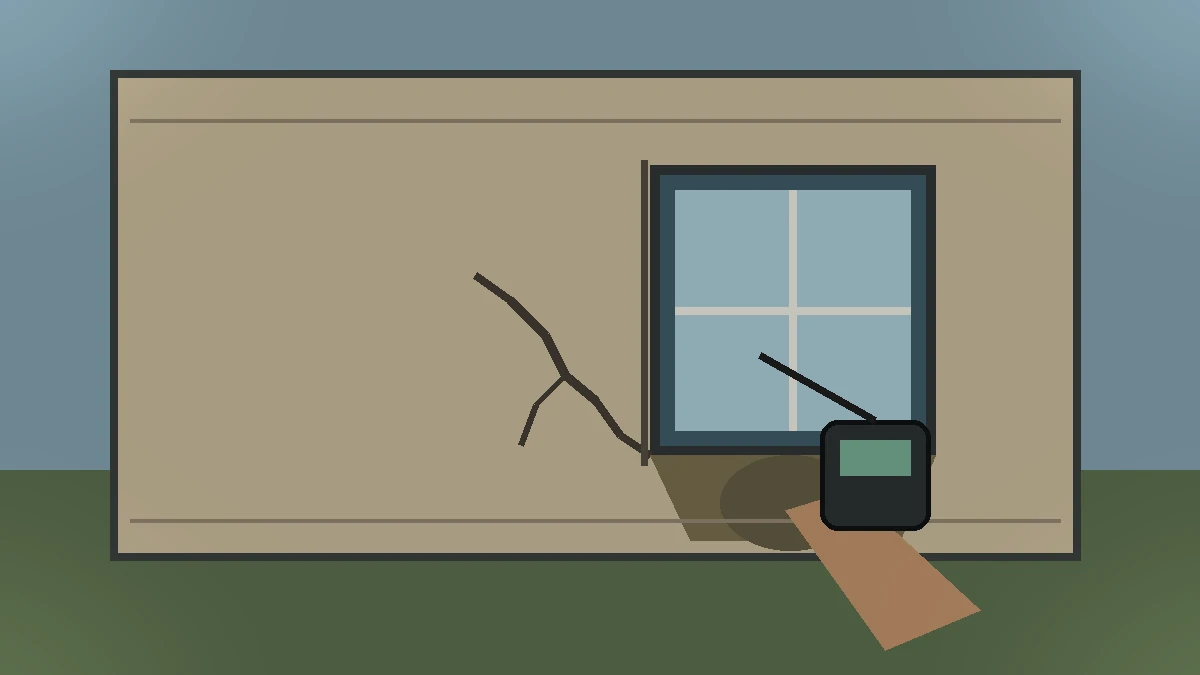
Stucco is an exterior finish, not a promise that the wall behind it is dry. Small cracks may be cosmetic, while other cracks can become entry points or signal movement, poor detailing, failed sealants, or concealed moisture. The buyer’s job is not to label every crack as harmless or serious. The job is to understand the pattern and decide what evidence is still missing.
How to read a stucco crack pattern
| Observation | What it may suggest | Why it needs context |
|---|---|---|
| Fine hairline cracking | Drying shrinkage, aging, or normal movement may be involved. | Width alone does not show whether water has entered or whether the crack is active. |
| Diagonal cracks from window or door corners | Stress concentration, movement, installation details, or missing reinforcement may be involved. | The opening, sealants, flashing, interior finishes, and repair history also matter. |
| Horizontal, stair-step, or displaced cracking | Movement in the wall, substrate, or structure may require deeper review. | A photograph cannot determine cause, stability, or repair scope. |
| Cracks with staining, blistering, softness, or odor | Moisture may have entered or remained in the assembly. | The source may be the stucco, a window, roof detail, plumbing, condensation, or another path. |
| Repeated patching or fresh coating | Prior movement or water entry may have been addressed. | A cosmetic repair can hide the pattern without proving that the source was corrected. |
Where water commonly finds a path
Wind-driven rain can reach cracks and weak details. Buyers should pay close attention around windows and doors, roof-to-wall intersections, parapets, balconies, penetrations, control joints, lower wall edges, and transitions between materials.
- Look for separated, missing, brittle, or heavily painted sealant around openings and penetrations.
- Check for staining below window corners, roof edges, vents, light fixtures, hose bibs, and wall transitions.
- Ask whether flashing or drainage details can be seen, documented, or evaluated.
- Compare exterior clues with interior stains, bubbling paint, swollen trim, musty odor, or past repairs.
Why the wall assembly matters
Stucco over concrete masonry behaves differently from stucco over framed walls with sheathing and a water-resistive barrier. Both can develop cracks and admit water, but the drying ability, concealed materials, and damage risk may differ. A buyer should know whether the wall is masonry, wood frame, light-gauge steel, EIFS, or another system before assuming the same repair fits every home.
Building-science guidance recognizes that stucco cracks and that water management must rely on drainage, flashing, water-resistant materials, and drying—not on a perfect, permanently crack-free face.
What moisture testing can and cannot show
A moisture meter, infrared camera, limited probe, or visual inspection can help identify areas that deserve attention. Results depend on the tool, wall material, weather, access, calibration, and the person interpreting the reading.
A dry reading during one visit does not guarantee that the wall has never leaked. A wet reading does not, by itself, identify the source or prove the full repair scope. Ask where readings were taken, what baseline was used, and whether destructive or invasive testing is recommended.
Why patch-and-paint may be incomplete
Some cracks can be repaired locally. Other conditions require work at windows, flashing, sealants, drainage paths, sheathing, framing, or interior finishes. Paint may reduce rain absorption when properly selected and applied, but paint should not be treated as proof that a concealed moisture path has been corrected.
There is no safe universal repair price. Scope depends on access, wall system, crack cause, concealed damage, permits, finish matching, openings, and how much material must be removed to reach sound construction.
Questions to ask before the inspection period ends
- What crack patterns were found, and which appear active, displaced, repaired, or moisture-related?
- What is the wall assembly behind the stucco?
- Are windows, doors, flashing, roof-to-wall details, joints, and penetrations included in the review?
- What interior evidence lines up with the exterior condition?
- Were moisture readings taken, where, and with what limitations?
- What records exist for prior leaks, stucco repairs, window replacement, coatings, permits, or insurance claims?
- Does the proposed repair address the water path and concealed damage, or only the visible finish?
Continue your buyer due diligence
Use the Contractor Homebuyer Guide for the broader property-condition process. Review the mold and moisture guide, the South Florida inspection red-flags guide, the four-point inspection guide, and the property survey guide when the exterior condition raises broader questions.

