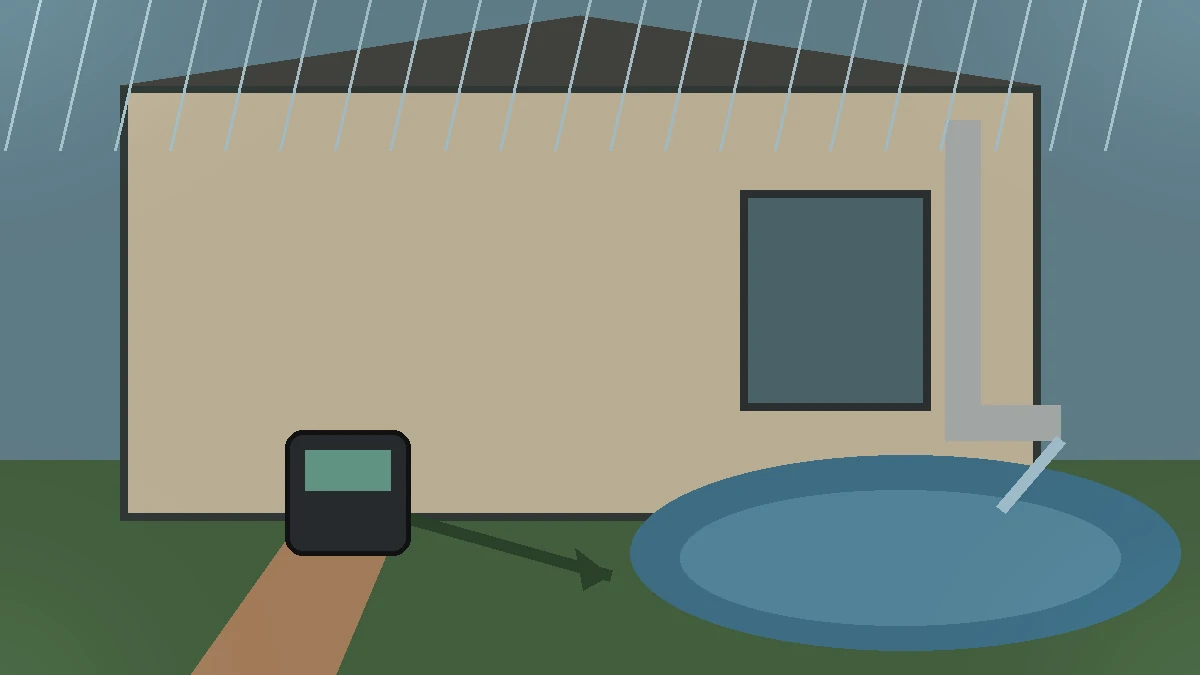
Florida rain can be intense, and many homes sit on flat lots with limited room for water to move. Drainage should be evaluated as a system: where the water starts, where it travels, where it collects, and who controls each part of the path.
How to read a drainage pattern
| Observation | What it may suggest | Why it is not enough alone |
|---|---|---|
| Water ponds near an exterior wall | Low grade, concentrated roof runoff, blocked drainage, or soil settlement may be involved. | A dry-day visit cannot show how often it happens or where the water begins. |
| Gutters overflow or downspouts discharge at the wall | Debris, undersized components, poor slope, missing extensions, or heavy rainfall may be involved. | Roof shape, rainfall intensity, underground connections, and discharge location also matter. |
| Erosion channels or exposed roots | Fast-moving runoff may be cutting through the soil. | The water may come from the subject roof, a neighbor, a roadway, irrigation, or several sources. |
| Soggy lawn or algae in one area | Poor drainage, over-irrigation, a buried drain issue, plumbing leak, or high groundwater may be involved. | Surface appearance alone does not identify the source. |
| Interior staining at lower walls or floors | Exterior runoff, wall leakage, plumbing, condensation, or flood entry may be involved. | Moisture location does not prove the route water used to enter. |
Grade, hardscape, and swales
Lots should generally direct surface water away from the building or toward an approved collection path. The Florida Building Code contains site-grading and impervious-surface slope requirements, but the applicable rule depends on the building, site, code edition, local conditions, and approved design.
Look at soil, patios, walkways, driveways, planters, landscape edging, and additions. A surface that once drained well may settle or become blocked. A swale can look like an unwanted dip, yet it may be part of the approved drainage path and should not be filled or obstructed without verification.
Gutters and downspouts
Roof water should be controlled so it does not repeatedly discharge beside the wall, cross an unsafe walkway, erode soil, or create a problem for another property. Ask where each downspout ends, whether underground piping exists, and where that piping discharges.
Redirecting a downspout may help in some settings, but it is not a universal repair. The new discharge point must have capacity, legal permission, and a safe route that does not shift the problem elsewhere.
Yard drains, French drains, pumps, and buried piping
A drain opening proves only that a system was installed. It does not prove the line is open, correctly sloped, connected to an approved outlet, large enough for the runoff, or maintained. Request plans, permits, invoices, cleaning records, pump information, and discharge locations when available.
Camera work, flow testing, excavation, elevation measurements, or engineering review may be needed when buried components or disputed flow paths matter.
Neighboring lots and public systems
Water does not stop at a property line. A higher neighboring lot, shared swale, retaining wall, roadway, canal, lake, association system, or municipal drainage network may affect the site. Do not assume the seller can control every source, and do not assume a public agency or association is responsible without records.
A survey can help identify boundaries, easements, elevations, and visible improvements, but a standard boundary survey does not automatically provide a complete drainage design or guarantee how water behaves during a storm.
Why a dry inspection can miss the problem
Drainage conditions are easiest to understand during or soon after meaningful rain. A dry yard during one visit does not guarantee that ponding, overflow, or intrusion has never occurred. Review seller disclosures, photographs, videos, repair invoices, permits, insurance history when available, and neighborhood observations.
What repeated drainage problems can affect
- Soil support and settlement near slabs, walkways, patios, and exterior walls.
- Stucco, sealants, doors, windows, and lower wall assemblies.
- Crawl spaces, garages, interior flooring, baseboards, and stored belongings.
- Landscaping, fences, retaining features, septic systems, pools, and neighboring property.
- Mosquito activity, erosion, slippery walking areas, and maintenance burden.
These outcomes are possibilities, not proof that damage exists. The condition, duration, frequency, and building details must be evaluated.
Why there is no universal drainage repair
A repair may involve cleaning gutters, extending downspouts, restoring grade, opening a swale, adjusting irrigation, adding approved drainage, repairing buried piping, correcting hardscape, managing roof runoff, or addressing a plumbing source. More complex conditions may require engineered elevations or coordinated work across multiple properties.
There is no safe universal drainage price. Scope, access, permits, discharge rights, excavation, landscaping, utilities, association rules, and the true water source can change the work substantially.
Questions to ask before the inspection period ends
- Where does roof water discharge, and can every outlet be traced?
- Which low areas are intentional swales, and which may reflect settlement or blockage?
- Has water entered the house, garage, crawl space, pool area, or adjacent structures?
- Are there permits, plans, surveys, elevation certificates, drainage studies, warranties, or repair invoices?
- Does the condition occur only in extreme storms, or during ordinary rain?
- Could irrigation, plumbing, septic, pool equipment, or neighboring runoff be contributing?
- Who owns and maintains each drain, swale, easement, canal, lake, or association component?
- What qualified professional should verify the cause and define the repair scope?

