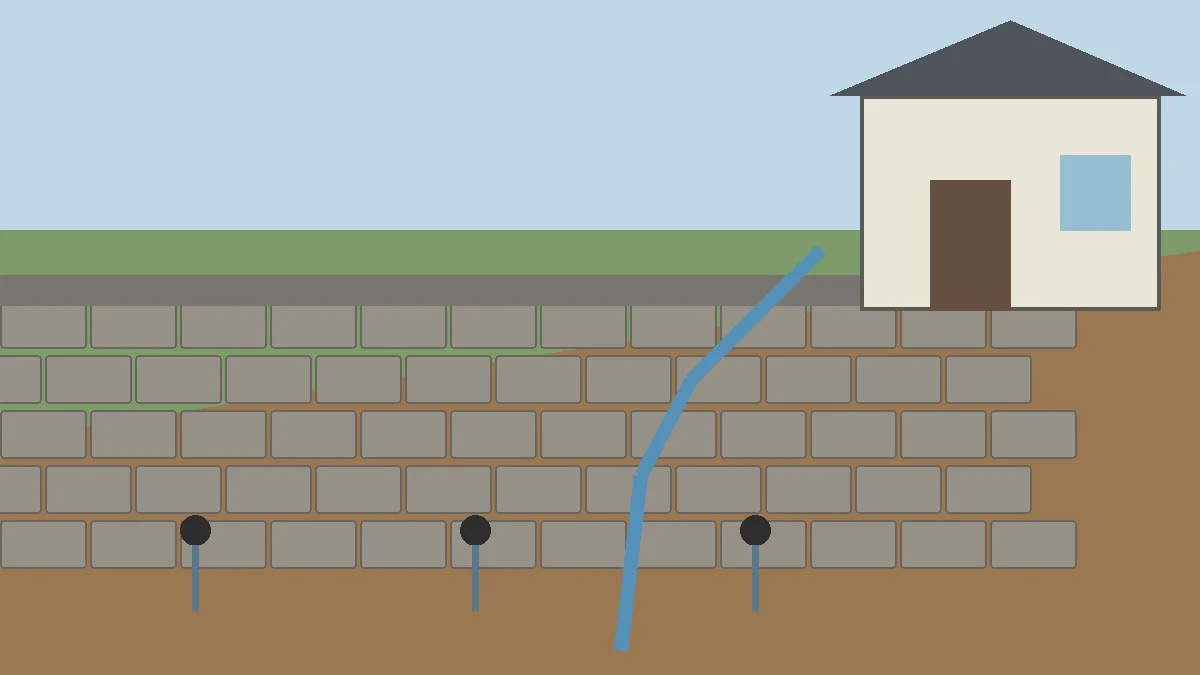
Retaining walls hold soil at different elevations. Their condition depends on the wall system, soil, drainage, foundation, reinforcement, nearby loads, maintenance, and changes made after construction.
First identify what the wall is doing
Some short landscape walls mainly shape planting beds. Other walls retain significant soil, support a driveway, pool deck, building area, fence, neighboring lot, or other load. Appearance alone does not show how much pressure the wall carries.
How to read retaining-wall clues
| Observation | What it may suggest | Why it is not enough alone |
|---|---|---|
| Wall leans or rotates | Soil pressure, weak footing, poor drainage, surcharge loads, or construction problems may be involved. | Old construction tolerances and later site changes must also be reviewed. |
| Bulging or displaced blocks | Backfill movement, connection failure, root pressure, saturation, or impact may be involved. | The visible face does not reveal reinforcement or buried conditions. |
| Horizontal, stair-step, or widening cracks | Movement, restraint, settlement, corrosion, or material shrinkage may be involved. | Crack width alone does not prove depth, activity, or structural importance. |
| Water stains, clogged outlets, or soil washing out | Drainage may be missing, blocked, undersized, or discharging poorly. | A dry-day visit may not show storm behavior or water pressure behind the wall. |
| Fresh paint, mortar, or replacement blocks | Maintenance or prior movement repair may have occurred. | Cosmetic work does not prove that drainage, footing, soil, or reinforcement was corrected. |
Why drainage matters behind the wall
Water in retained soil adds pressure and can carry soil through joints or around the wall. Federal engineering guidance identifies inadequate drainage as a major contributor to retaining-wall problems. Buyers should look for drainage aggregate, outlets, weep holes, pipes, swales, gutters, irrigation, erosion, and where water can safely discharge.
A visible outlet does not prove the system is open, correctly placed, or adequate. A dry wall during one visit does not guarantee that pressure does not build during heavy rain.
Read the slope above and below
Look beyond the wall face. Review the slope angle, bare soil, erosion channels, settlement, trees, roots, fences, pools, driveways, sheds, additions, vehicles, and neighboring improvements. Loads placed near the top of a wall can change the forces acting on it.
Permits, plans, surveys, and responsibility
Ask for permits, engineering plans, product information, surveys, easements, association records, warranties, invoices, photographs, and prior reports. A survey may help identify boundaries and improvements, but it does not automatically establish structural adequacy or ownership of every maintenance duty.
Do not assume a wall belongs to the property merely because it faces the yard. Shared boundaries, easements, associations, neighboring parcels, canals, roads, or public systems may affect responsibility.
Why patching may not define the repair
Repair can range from drainage cleaning or localized masonry work to excavation, rebuilding, soil stabilization, engineered reinforcement, or coordinated work with adjacent owners. Painting, sealing, adding mortar, or replacing a few blocks may improve appearance without correcting the cause.
There is no safe universal retaining-wall price or remaining-life estimate. Height, access, demolition, excavation, drainage, soil, utilities, permits, engineering, property boundaries, nearby structures, and material type can change the scope substantially.
Questions to ask before the inspection period ends
- Is the wall decorative, or does it retain soil supporting a structure, driveway, pool, or neighboring property?
- Is there visible lean, bulging, rotation, settlement, cracking, erosion, or soil loss?
- Where does water behind and above the wall come from, and where does it discharge?
- Are drains, weep holes, outlets, or buried piping present and functioning?
- Were permits and engineered plans required, and are they available?
- Have loads, grading, irrigation, trees, fences, pools, sheds, or driveways changed since construction?
- Who owns and maintains the wall and the land it supports?
- What qualified professional should determine stability and define the repair scope?

